
From automating routine tasks to generating clinical documentation and insights, there are many examples of AI in health care. A new phase of AI is emerging that goes beyond automation or content creation. Known as agentic AI, this approach has the potential to fundamentally change how work gets done across health care organizations.
Rather than acting in isolation, AI agents for health care use multiple intelligent agents that can make decisions, take action and coordinate with one another to achieve an outcome. For health systems navigating workforce shortages, administrative burden and increasingly complex workflows, this shift from automation to intelligent orchestration could be transformative.
What is agentic AI?
Traditional automation and AI tools are designed to perform specific tasks like flagging an issue, generating a recommendation or producing content. Generative AI, for example, excels at summarizing information or drafting text, but typically stops short of acting on that information.
Agentic AI works differently. It involves connected agents that can understand a situation, determine the next step and communicate with other agents to move a process forward.
Becky Buchen, senior vice president for innovation and transformation at OSF HealthCare, describes agentic AI as the next phase in AI’s evolution. Early software bots followed rules humans programmed into them, but as AI has advanced, those bots can now learn from data and generate insights. Agentic AI builds on that foundation by enabling agents to anticipate what comes next and coordinate actions across an entire workflow.
A common example is revenue cycle management. One agent may identify why a claim was denied, and another agent can determine how to fix the issue. A third agent can submit the corrected claim. Rather than relying on humans to predefine every rule or determine next steps, , the agents work together, using data and insights to complete the process from end to end.
From Automation to Orchestration
What makes AI agents for health care powerful is not just speed, but coordination. Health care workflows usually involve multiple systems and teams. Agentic AI can help bridge those gaps by orchestrating tasks across technologies that don’t naturally work together.
However, this doesn’t mean you can turn an agentic AI solution on and never check on it.
“At OSF, we would need to supervise AI agents much the same way we would supervise our Mission Partners,” Buchen explains.
Leaders don’t give a team member tasks and never check in again. They monitor performance, watch for changes and intervene when something isn’t working as expected.
That same mindset applies to agentic AI. Instead of noticing a problem weeks later on a dashboard, leaders will need to understand what “normal” looks like and recognize early signals when something breaks, whether due to a data gap, process change or system integration issue.
This shift requires leaders to think differently about oversight. As AI agents take on more interconnected tasks, leaders will need to be educated and upskilled to understand how those agents operate, interact and depend on one another. Much like managing a team, leaders must be prepared to assess when an agent’s behavior or outputs change, diagnose what caused the disruption and intervene when necessary.
Key Benefits of AI Agents in Health Care
When applied thoughtfully, agentic AI can deliver meaningful benefits across health care systems.
- Reducing administrative burden: Many health care teams are stretched thin by repetitive, time-consuming tasks. Agentic AI can take on that work, allowing providers to focus on complex problems that require human judgment and critical thinking.
- Improving efficiency and scalability: Automating multi-step workflows can help organizations manage staffing challenges, reduce repetitive tasks and save money over time.
- Creating more seamless experiences: By understanding context and preferences, agentic AI can help deliver more responsive, personalized interactions for patients and care teams.
- Matching patients with clinical trials: Agents could continuously analyze patient records, genomic data and treatment histories to identify patients who meet complex eligibility criteria and match them with relevant trials. Once a match is identified, the system could alert care teams, confirm eligibility and coordinate patient outreach.
Roopa Foulger, vice president of Digital Innovation Development at OSF Innovation, points to hospital throughput and discharge planning as another opportunity. An agentic system could monitor clinical indicators and care plans to anticipate when a patient may be ready for discharge and initiate the necessary steps. Agents could then coordinate discharge documentation, follow-up care and post-acute services, helping ensure smoother transitions while improving hospital capacity.
Is health care ready for agentic AI?
While the promise of agentic AI is significant, most applications in the health care space are still in testing phases.
“In health care, you have to be at 100% accuracy to feel confident using these tools,” Foulger notes. She compares the current state of agentic AI to autonomous vehicles, which have been tested for years and are still evolving.
Today, many of the most promising use cases are operational rather than clinical. Financial workflows, supply chain and logistics, patient access and administrative processes are often more structured, making them better candidates for early adoption.
At OSF, individual bots are already in use across areas like finance and clinical decision support. Connecting those bots into fully orchestrated, outcome-driven agentic systems is an active area of exploration and testing.
Safety, Data and Responsible Adoption
Agentic AI is only as effective as the data behind it. Clean, governed and well-understood data is essential, especially when multiple agents rely on shared information.
“If one agent has the wrong data, it can pass incorrect information to the next agent,” Buchen explains. That risk grows as more agents are layered into a process.
Foulger adds that real-world simulation is critical. What makes sense in a controlled design environment may fail when used by real people, across real systems, under real-world conditions. Integration failures, identity verification issues and access challenges all need to be tested and planned for in advance.
Building the Right Foundation
Successfully implementing AI agents for health care requires more than technology. It demands new ways of working.
Foulger emphasizes the importance of cross-functional, close-knit teams when building new processes that incorporate agentic AI.
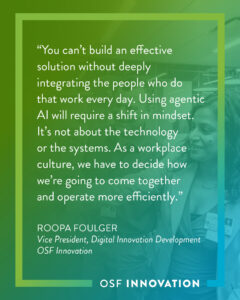
“You can’t build an effective solution without deeply integrating the people who do that work every day,” she says. “Using agentic AI will require a shift in mindset. It’s not about the technology or the systems. As a workplace culture, we have to decide how we’re going to come together and operate more efficiently.”
Insert graphic with quote above
At OSF, that shift is supported by a growing focus on AI literacy, executive education and governance. That governance will continue to evolve along with artificial intelligence trends in health care.
Looking Ahead
Agentic AI represents a meaningful step forward in how health care work can be designed and delivered. By orchestrating tasks across people, processes and technology, it has the potential to reduce friction, improve efficiency and allow health care workers to focus on what they do best. The future of AI agents in health care won’t be defined by how quickly it’s deployed, but by the efficiency it creates.
Last Updated: October 14, 2026