
If you need medical care quickly, you may wonder whether to choose urgent care or the emergency room (ER).
Knowing the difference between urgent care vs. emergency room services can help you get the right level of care without unnecessary cost or wait time.
“If you believe you have a life-threatening injury or illness, please call 9-1-1 or go to the nearest emergency room,” said Kate Barth, chief nursing officer and vice president of On Demand Services at OSF HealthCare.
For non-life-threatening illnesses and injuries, going straight to the emergency room or the emergency department (ED) may not be the best option.
Need to talk to a provider?
Urgent care clinic options, such as OSF PromptCare, OSF Orthopedics Walk-In Clinic and OSF OnCall Urgent Care, which has walk-in clinics and virtual visits, may be a better choice.
Urgent Care vs. Emergency Room: How to Decide
When deciding between urgent care or ER, three key factors help guide your choice:
- Severity of your condition
The ED is for life-threatening, severe or complex symptoms. Urgent care treats minor illnesses or injuries.“If a medical problem poses a real risk to life or loss of limb, it should be treated as an emergency and evaluated in the emergency room,” Kate said. - Cost
ED visits typically cost significantly more than urgent care visits. That means you don’t want to go to the emergency room for something you can easily get taken care of with urgent care. - Wait time
EDs treat the sickest patients first, so you may wait longer at an ED if you have a minor condition that can be treated with urgent care options.“Emergency departments must prioritize the most severe cases,” Kate said. “Urgent care clinics help ensure patients get the exact care they need without unnecessary delays.”
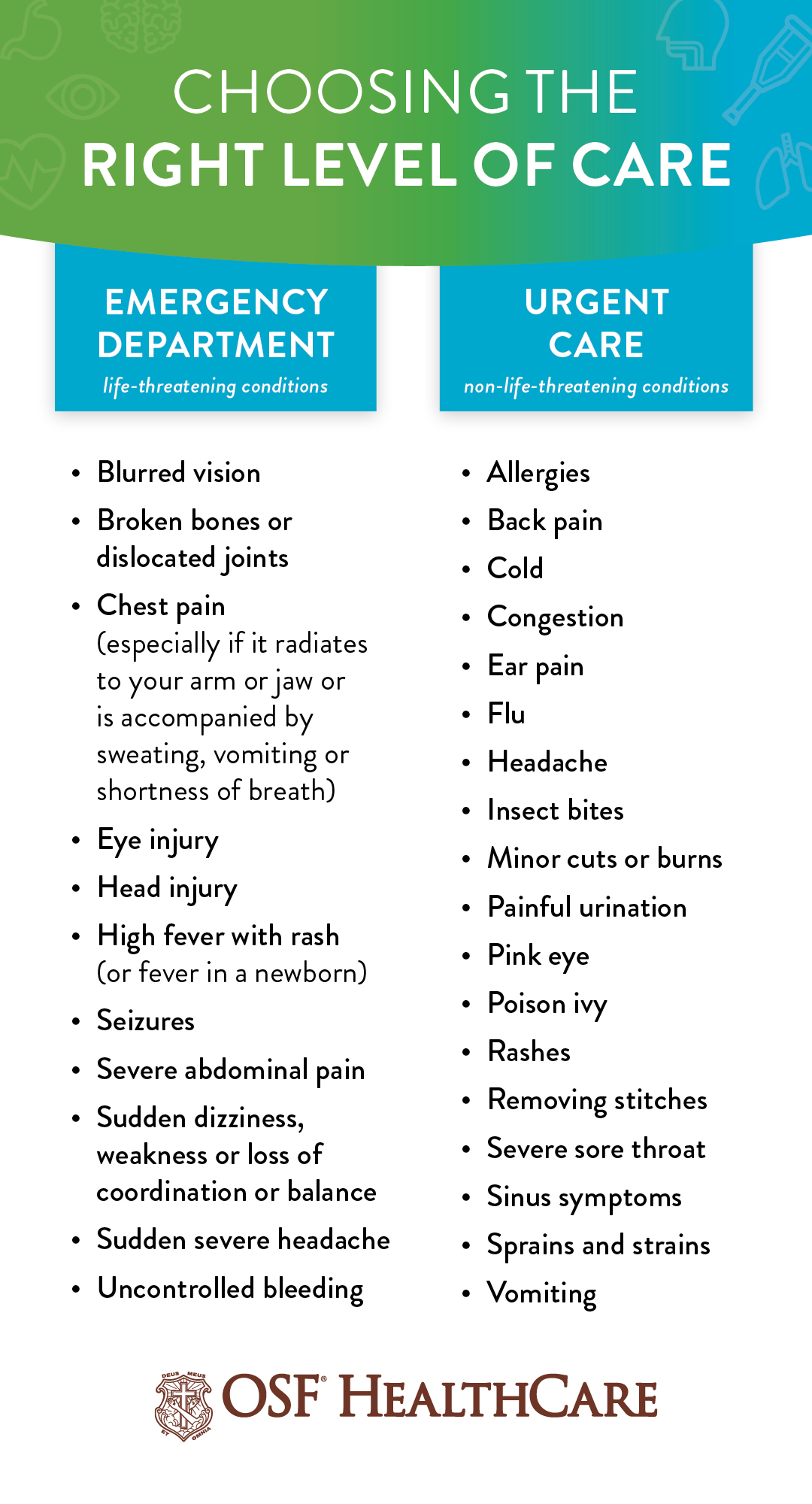
When to Go to the Emergency Room
An ED is for treating serious and life-threatening conditions. EDs are open 24/7 and equipped to provide advanced care, imaging and emergency procedures.
“The emergency department should be reserved for the most severe situations,” Kate said. “That allows care teams to focus their resources on patients who need immediate, advanced medical attention.”
Go to the emergency room immediately if you experience:
- Chest pain (especially if it spreads to the arm or jaw, or includes sweating, vomiting or shortness of breath)
- Severe shortness of breath
- Sudden weakness, numbness or slurred speech
- Blurred vision or sudden dizziness
- Head or eye injury
- High fever with rash (or fever in a newborn)
- Seizures
- Severe abdominal pain
- Uncontrolled bleeding
Kate added that you should also use the emergency department if you have a complicated medical history.
When to Call 9-1-1
Even if it’s clear you need emergency care, you may wonder whether to drive yourself to the hospital or call 9-1-1.
You should call 9-1-1 if you or a loved one:
- Have severe chest pain
- Have been severely injured or fallen
- Are having trouble breathing
- Have uncontrolled bleeding
- Feel faint or are losing consciousness
- Have sudden weakness, slurred speech or stroke symptoms [link to https://www.osfhealthcare.org/services/specialties/neurosciences/conditions-treatments/stroke]
- Experience a serious head injury
- Have taken a drug overdose
- Are experiencing a severe allergic reaction
If you decide to call an ambulance, emergency medical professionals will begin treatment on the way to the hospital. In cases like a heart attack or stroke, that early care can make a critical difference.
If you are unsure whether to choose urgent care or the emergency department and the symptoms are severe, call 9-1-1. It is always better to be safe and get help quickly.
When to Use Urgent Care
Urgent care clinics treat non-life-threatening illnesses and injuries that need prompt attention.
You should use urgent care for things like:
- Allergies, cold and flu
- Back pain
- Earaches, fevers and headaches
- Foreign object in the eye or nose
- Insect bites
- Minor allergic reactions
- Minor burns or bruises
- Minor fractures
- Occupational health services
- Pink eye
- Rashes and skin concerns
- Scrapes and minor cuts
- Sore throats
- Sprains and strains
- Stitches for minor wounds
- Urinary tract infections
- Upper respiratory infections with mild symptoms
“Urgent care personalizes each visit to ensure timely, convenient medical treatment for non‑life‑threatening illnesses and injuries, giving patients access to the right level of care without the wait of an emergency room,” Kate said.
At OSF OnCall Urgent Care and OSF Orthopedics Walk-In Clinic, non-emergency visits are often completed within approximately 30 minutes.
Questions to Ask Yourself: Should I go to the ER or urgent care?
If you’re experiencing symptoms, you may want to “quiz” yourself to determine if the ED or urgent care is right for you.
Asking yourself a few key questions can help guide your decision:
- Is my condition so severe that my life is in danger?
- Am I having chest pain, trouble breathing or severe bleeding?
- Did symptoms start suddenly and feel severe?
- Could waiting make this significantly worse?
If you answer yes to any life-threatening symptoms, go to the ED or call 9-1-1.
If your symptoms are stable but need same-day care, urgent care is the best choice.
Let Digital Tools Help You Decide
OSF HealthCare has other ways to help patients determine the level of care they need.
“We also have digital tools designed to meet people where they are or get them to the most appropriate care setting if they cannot be treated virtually,” Kate said.
Tools like Clare, a digital chatbot available 24/7 on the OSF HealthCare website Simply click on the photo of Clare in the lower right corner, and she will guide you through a series of questions to help determine where to go for care.
OSF OnCall Urgent Care virtual visits provide 24/7 health care through your computer, tablet or smartphone. A board-certified provider can diagnose and recommend treatments for a variety of minor illnesses and injuries.
Last Updated: May 26, 2026